

How To Determine What Size Motors And Battery You Need For Your Drone
ByLauren Nagel
Published: 25-05-2021, Last updated: 13-10-2021
The drone engineering process often operates as a 'design loop', which refers to the round nature of the design process. Building the starting time version of the drone relies on certain assumptions, many of which volition change every bit components are selected and the design comes together.
In this article we will comprehend:
- Finding a battery to increase flight fourth dimension
- How to choose a drone motor and propeller (with database)
- Swapping components to maximize efficiency
- How to choose an ESC
- How to calculate drone flight fourth dimension
The pattern loop begins when the designer looks at how the outset version of the design differs from the assumptions, then goes back to the get-go with the new information (effigy 1).

Figure ane: The drone design loop illustrated
In our previous article, How to Increment a Drone's Flying Time and Lift Capacity , we covered the starting time stage of the blueprint procedure and reached a first version of our pattern. In this article we will start where we left off, looking at how our assumptions held up.
Review
Nosotros started our design process with the assumption that our drone would weigh 777 one thousand and would be able to fly on its own. Post-obit these assumptions, we predicted we would need 1.nine N of thrust per propeller for hover flying, so we looked for the motor-propeller combination that would be nearly efficient at ane.nine N. Once we found the most efficient combination, nosotros had the tools needed to gauge our flight time, which is where nosotros will start off today.
For this article we will be more than precise with the mass of our components. We will assume the following mass breakdown of our 777 g drone:
- Motors (iv): 148 thou
- Propellers (4): thirteen.5 g
- Battery (i): 155 g
- Other components (camera, frame, ESC, etc.): 460.five g
Flying Time
Our goal is to maximize our drone's flight fourth dimension so that it can hover equally long as possible. In our previous article, we modelled the flight time of our drone with varying battery capacity (effigy two).

Figure 2: Flight time vs. battery capacity for the original drone design
We presumed our pattern would include a Turnigy nano-tech 1300 mAh 4S battery and included its mass in our overall calculations. The battery'southward capacity is just over 19.2 Wh (fourteen.viii Five * one.three Ah = 19.2 Wh), which occurs within the growth phase of the graph and gives us simply about 4.5 minutes of flight time. If nosotros increased the battery capacity, we could also increase our flight time, but the trade off would be increased weight. This is where the design loop begins, every bit we swap components to effort and build the drone that best meets our needs.
Iteration 2: Choosing a New Battery for Maximum Flight Fourth dimension
Upwards to the 0.2 hour marking there is an increment in flying fourth dimension with increased battery capacity, but after about 100 - 125 Wh the marginal gains go less meaning. For this reason, we volition start by swapping our old bombardment with a new battery that has around 100 - 125 Wh of capacity in order to increase our flight time. The Turnigy 5000mAh 6S LiPo pack nicely fits our criteria with 111 Wh of capacity (figure 3).

Effigy 3: Turnigy 5000 mAh/ 111 Wh LiPo battery (Photo: HobbyKing)
This new battery weighs a whopping 655 g compared to our former battery that weighed just 155 k. Assuming all of our other components stay the same at 622 thousand, the total mass of our drone is at present i,277 yard. We will therefore need to produce at to the lowest degree 12.5 North of thrust for the drone to hover (1.277 kg * 9.81), just over 3.i N per propeller. We would also like to accomplish at to the lowest degree double that thrust to have a good control authorization, and so we will be looking for the propeller that is most efficient at 3.one Northward, but tin can besides achieve upwards to vi.2 N of thrust.
To review, nosotros have 3 propellers in our list of candidates:
- 6030R Gemfan => diameter: 6", pitch: 3", mass 2.22 g
- 6040R Male monarch Kong => diameter: 6", pitch: iv", mass 3.38 g
- 5030R Gemfan => diameter: 5", pitch: 4", mass three.00 k
We will work with the assumption that our drone frame is set up and we cannot exceed 6" in diameter for our propellers. We tin learn about our three propeller candidates past looking through the RCbenchmark database of electric motors, propellers and ESCs. Test data such as thrust, torque, RPM, ability, efficiency and more is collected using one of our propulsion test stands, and for this drone the RCbenchmark Serial 1585 would probable exist the best fit.
For our candidates, data from the database tells us that all iii propellers reach our hover thrust of 3.i N, but only the 6040R King Kong nears the maximum thrust of 6.2 Northward (0.63 kgf) (figure 4).

Effigy 4: Thrust performance of the propeller candidates
These results suggest that either our battery is besides heavy or our motor/ propeller combination was not producing sufficient thrust. We are aiming to have the longest flying fourth dimension possible, and then rather than looking for a smaller battery right away, let's explore some more propellers that fit inside our frame limits, only produce more thrust.
Farther reading: Automated Tests for Your Brushless Motors and Propellers
Iteration 3: Choosing New Propeller and Motor Candidates
Our frame limits us to propellers that are 6" or less in diameter, simply we can yet experiment with our pitch, material, and make. Nosotros will use the drone component database to filter for propellers that are vi" in diameter and produce at least vi.two N (0.63 kgf) of force. This search provided several good options, but for simplicity we will narrow it down to 3 candidates that produce the almost thrust:
- Propeller 1 → diameter: 6", pitch: 4", mass: 3.38 g, material: plastic
- Propeller 2 → bore: 6", pitch: 4", mass: iv.32 g, material: nylon
- Propeller iii → diameter: half-dozen", pitch: 4.5", mass: half-dozen.78 g, material: carbon fiber (CF)
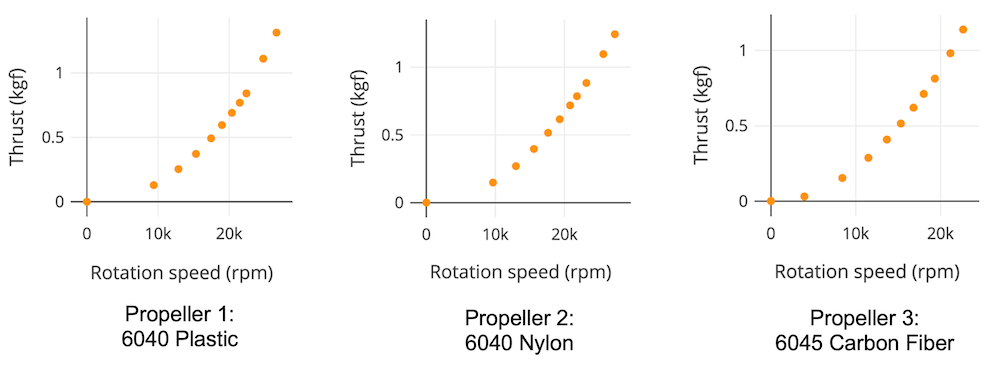
Figure v: Thrust vs. RPM for the new propeller candidates
As you can see in figure 5, all of our propeller candidates tin produce x North (1 kgf) of thrust or more. For this reason, we can aim for a hover thrust of 5 Due north and a max thrust of 10 N, which volition permit us to lift a larger battery with the same propulsion unit.
As shown in effigy vi, at our original hover thrust of 3.1 Northward (0.32 kgf) and at our new hover thrust of five.0 Due north (0.51 kgf) the efficiency of propeller i and propeller 2 is very similar, separated past only nearly 0.1 gf/W. Propeller 2 is slightly more than efficient, only it is as well heavier. This increased weight could lead to a shorter flight time and leaves less mass available for the battery. In a quadcopter, the total difference would exist 3.76 g ((four.32 g - iii.38 one thousand)*4).

Figure vi: Propeller efficiency vs. thrust for the new propeller candidates
After a quick look at the online marketplaces, it is evident that 4g makes no difference in terms of capacity for batteries of this size. For this reason, and the negligible outcome of iv thousand of mass for our drone, it makes sense to use propeller ii due to its higher efficiency.
Our next step will exist to notice the brushless motor that is near efficient with this propeller at our new hover thrust of 5 N. In general, we are looking for a motor that can exceed our max thrust of 10 N, just non by besides large a margin. We don't want to operate the motor at its maximum speed for too long, but we besides don't want to haul a motor that produces more thrust and torque than we need.
Of the two motors we tested previously, MultiStar Aristocracy 2306 2150 Kv and EMAX RSII 2207 2300 Kv, only the 2300 Kv motor meets our max thrust requirement (effigy 7). Nosotros will therefore have to use the motor database to find a new candidate.

Figure 7: Motor efficiency vs. thrust for 2150 Kv and 2300 Kv motor candidates
From the database we find the Hypetrain Blaster 2207 2450 Kv, which meets our criteria. Nosotros ran a test with each of the two motors paired with propeller 2, and the results are shown in figure 8. Motor two, EMAX RSII 2207 2300 Kv, is the well-nigh efficient with propeller two at our hover operating point of v N (0.51 kgf) and it also happens to be more than efficient at our max thrust of 10 Due north (i.02 kgf). The efficiency departure at hover thrust is about 2.2% (55.vi% vs. 53.4%), just the 2300 Kv motor is also lighter (32.37 g vs. 36.96 g), and so it makes our decision easy.

Figure 8: Motor efficiency vs. thrust for 2300 Kv and 2450 Kv motor candidates
Iteration 4: Choosing a New Bombardment for Maximum Flying Fourth dimension That Fits Our New Design
At present is a good time to summarize the mass of our components since the mass of our propellers and motors has changed as well as our hover thrust. Here is the new breakup:
- Motors (iv): 129.five g
- Propellers (4): 17.3 g
- Other components (camera, frame, ESC, etc.): 460.5 g
- Pre bombardment mass: 607.three thou
- Max mass: ~ 2,000 g
Based on these new values, we have 1392.7 g of mass available for our battery.
Since we besides have our motor and propeller picked out, we can also decide our discharge (C rating) needs, which will also be a consideration for picking out the bombardment. We want to exist certain that our motor will not draw more current than our battery can provide, or else the battery could chop-chop degrade or overheat. The formula for determining current depict for a battery is: Current (A) = C rating * Capacity (Ah).
Further reading: Brushless Motor Power and Efficiency Analysis
There is no information on continuous or burst electric current for the EMAX RSII 2207 2300 Kv online, but we can look at data in the RCbenchmark database and compare all tests washed with this motor. As we can see in effigy 9, the max current reached during diverse tests was virtually 42 A.

Figure 9: Electric current vs. Rotation speed for EMAX RSII 2207 2300 Kv motor
The Turnigy High Capacity 16000 mAh 4S 12C Lipo Pack has the highest capacity in Wh of all the batteries in our weight range, giving us 4 * iii.7 * sixteen = 236.eight Wh. Information technology weighs 1,366 k, has a 12 C discharge rating and xvi Ah of chapters, then it can handle a current draw of 192 A, which is more we need.
Iteration 5: Choosing an ESC
The main consideration for choosing an ESC is that information technology tin can deliver the motor'due south peak electric current. In our case nosotros practise non expect our motor to exceed 42 A, so an ESC like the HobbyKing 60A ESC 4A SBEC volition piece of work great. It can deliver a constant current upwardly to 60 A and a burst current up to 80 A, while providing 4 A to the BEC. This gives us a fleck of a rubber margin, and then this ESC will exist a good pick for our drone.

Figure x: HobbyKing 60A ESC 4A SBEC (Photo: HobbyKing)
Calculating Our Flying Time
As we learned in our previous article, flight time is dependent on the capacity of the battery and the ability drawn by the propulsion system. Many factors thus come in to play, summarized in the formula below (see previous article on increasing flying time for more details):

Where
E = capacity
σ = energy density
Chiliad = mass in grams (g)
Nosotros can re-create+paste our propulsion test data into this handy flight time reckoner , plug in our weight and battery capacity, and it will give united states of america the best estimate of our flight time based on our data. Our estimated flight time is xv.ii minutes (figure 11), which is a significant comeback compared to our original pattern, which had merely about 4.5 minutes of flight fourth dimension.

Figure 11: Using the flight fourth dimension calculator to estimate our drone's flight time
Conclusion
As nosotros have seen, the drone design process is cyclical and in that location'due south about always room to improve a design. Collecting propulsion data is ane of the best ways to determine where in that location is room for improvement in your drone, and nosotros offering many test stands and tools to assist you lot do so.
If you enjoyed this article, you will also enjoy our free eBook:Drone Building and Optimization: How to How to Increase Your Flight Time,
Payload and Overall Efficiency.

How To Determine What Size Motors And Battery You Need For Your Drone,
Source: https://www.tytorobotics.com/blogs/articles/the-drone-design-loop-for-brushless-motors-and-propellers
Posted by: greenwhisfat.blogspot.com
0 Response to "How To Determine What Size Motors And Battery You Need For Your Drone"
Post a Comment